


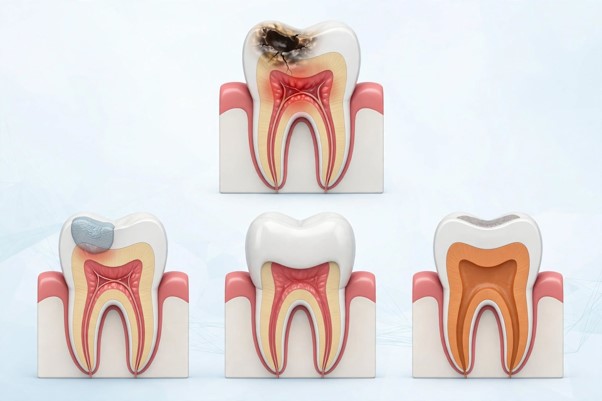
When a tooth becomes damaged, choosing the right treatment can feel confusing. You may need a filling, a dental crown, or root canal treatment, depending on the extent of the damage and whether the inner part of the tooth is affected.
Although these treatments can sometimes be used together, they serve different purposes. Understanding filling vs crown vs root canal treatment can help you know what your dentist may recommend and why saving your natural tooth is often an important priority.
When Is a Dental Filling Enough?
A filling is commonly used to repair a tooth affected by decay or minor damage. After removing decay when necessary, the dentist fills the prepared area with a suitable restorative material.
Fillings are often appropriate when the damage is limited and enough healthy tooth structure remains to support the restoration.
Signs You May Need a Filling
You may need a filling if you have a cavity, food repeatedly catching in a damaged area, or sensitivity associated with tooth decay. However, these symptoms do not confirm the diagnosis, and some cavities cause no noticeable pain.
Early assessment can help prevent decay from progressing into deeper layers of the tooth.
When Does a Tooth Need a Crown?
A dental crown covers and protects a tooth when it needs more support than a conventional filling can provide. Crowns may be recommended for significantly weakened, heavily restored, cracked, or broken teeth, depending on the location and extent of the damage.
Unlike a filling, which repairs a particular area, a crown covers most or all of the visible portion of the tooth above the gumline.
A crown may help restore chewing function and reduce the risk of further damage when the remaining tooth structure is vulnerable. However, it is not necessary for every damaged tooth.
If your dentist has recommended a crown, explore dental crowns in Brandon to learn more about how they restore and protect weakened teeth.
When Is Root Canal Treatment Necessary?
Root canal treatment may be required when the pulp inside a tooth, which contains nerves and blood vessels, becomes irreversibly inflamed or infected.
This can happen because of deep decay, a crack, trauma, or repeated dental procedures. Symptoms may include persistent toothache, prolonged sensitivity to heat or cold, pain when biting, or swelling. However, some affected teeth have few obvious symptoms.
During root canal treatment, the dentist removes the affected pulp, cleans and disinfects the root canal system, and seals it. The tooth can then be restored to help it function again.
Root canal treatment is intended to save a natural tooth that might otherwise need extraction. Depending on how much tooth structure remains, a crown may also be recommended afterwards to protect it from fracture.
Can You Need a Filling, Crown and Root Canal Together?
Yes. These treatments are not always alternatives to one another.
For example, a tooth with deep decay may need root canal treatment to address the affected pulp, followed by a crown to protect the remaining structure. A smaller cavity may need only a filling.
The recommended treatment depends on the diagnosis, the amount of healthy tooth remaining, the location of the damage, and the long-term outlook for the tooth.
If you have persistent pain or swelling, seek prompt dental assessment. You can also review emergency dental treatment if your symptoms are severe or require urgent attention.
Frequently Asked Questions
Is a crown better than a filling?
A crown provides more extensive coverage and may be suitable for a significantly weakened tooth. A filling is generally preferred when the damage is smaller and enough healthy tooth structure remains. The most conservative suitable option is usually worth discussing with your dentist.
Does root canal treatment mean the tooth is badly damaged?
Root canal treatment means the pulp inside the tooth needs treatment, but it does not automatically mean the tooth must be removed. Many teeth can be preserved with appropriate root canal treatment and restoration.
Can a tooth heal without a root canal?
Mild inflammation may sometimes settle after the cause is treated, but an irreversibly inflamed or infected pulp may require root canal treatment or extraction. Your dentist must assess the condition before recommending treatment.
How do I know whether I need a filling or a crown?
A dental examination, and sometimes X-rays, helps determine how extensive the damage is and how much healthy tooth structure remains. Symptoms alone cannot reliably distinguish between the two.
Protect Your Natural Teeth with the Right Treatment
A filling, crown, and root canal each address different dental problems. Early diagnosis can help identify the least invasive treatment that is appropriate for your tooth and reduce the risk of further damage.
Discuss your symptoms and treatment options with your dentist so you understand the benefits, limitations, and expected care involved.