


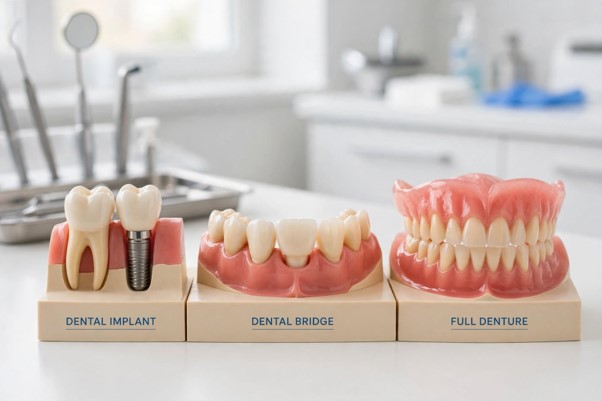
Missing teeth can affect more than your smile. You may find it harder to chew comfortably, feel self-conscious when speaking or smiling, or notice that your remaining teeth have started to move. The good news is that several treatments can replace missing teeth, but the right choice depends on your oral health, budget and long-term goals.
If you are comparing dental implants vs bridges vs dentures, this guide explains the main differences, expected treatment times, costs and benefits to help you prepare for an informed conversation with your dentist.
Dental Implants, Bridges and Dentures: What’s the Difference?
Dental implants: Dental implants replace missing tooth roots with small posts placed in the jawbone. Once healing is complete, a custom crown, bridge or denture can be attached. Implants are fixed in place and do not rely on neighbouring teeth for support in the same way as a conventional bridge.
Dental bridges: Dental bridges replace one or more missing teeth using neighbouring teeth or implants for support. A conventional tooth-supported bridge usually requires the supporting teeth to be prepared to hold the restoration.
Dentures: Dentures are removable appliances that replace some or all missing teeth. They may be made from acrylic or other materials and can be suitable for patients missing several teeth or a complete set.
Implants vs Bridges vs Dentures: Comparison Table
The following table compares the main features of dental implants, bridges and removable dentures to help you understand which option may suit your needs.
| Factor | Dental Implants | Dental Bridges | Removable Dentures |
|---|---|---|---|
| How they work | An implant supports a crown, bridge or denture. | Supported by neighbouring teeth or implants. | Rests on the gums and may use clasps for support. |
| Best suited to | Selected patients replacing one or more teeth. | Replacing a gap when suitable supporting teeth are available. | Replacing several or all missing teeth. |
| Treatment time | Often several months, depending on healing and complexity. | Commonly a few weeks, depending on the case. | Usually several appointments over weeks. |
| Indicative cost | Often the highest initial cost for a single-tooth replacement. | Varies by bridge design and number of units. | Often a lower initial cost, depending on type. |
| Main benefit | A fixed restoration that can help preserve bone in the implant area. | A fixed replacement without implant surgery. | Removable and generally less invasive. |
| Main limitation | Requires surgery, suitable bone and ongoing maintenance. | May require preparation of supporting teeth. | Can move or feel bulky and may need adjustments. |
| Longevity | Implants can last many years; crowns may need replacement. | Often around 5–15 years, sometimes longer. | Often around 5–10 years, depending on fit, materials and care. |
Note: These timeframes and lifespans are general guides, not guarantees. Individual results depend on oral health, the type of restoration, daily cleaning and regular dental reviews.
How Much Do Dental Implants, Bridges and Dentures Cost?
The cost of replacing missing teeth depends on how many teeth need replacing, the material used and the complexity of treatment.
Implant treatment may involve consultation, scans, surgery, an abutment and a final crown. Bone grafting or other preparatory procedures can increase the total. A bridge’s price depends on its design and the number of units, while denture costs vary according to whether you need a partial or full denture and which material is selected.
For an accurate comparison, ask for a written treatment plan that sets out the full cost, expected appointments, maintenance and any additional procedures. The lowest initial price is not always the most suitable long-term option.
Why Choose an Implant Assessment at Brandon Dental Clinic?
At Brandon Dental Clinic, an implant assessment can help establish whether implants are appropriate for your needs and how they compare with bridges or dentures. Assessment may include reviewing your medical and dental history, examining your gums and teeth, and evaluating the available bone.
CBCT imaging, when clinically indicated, provides three-dimensional information that can help assess bone anatomy and plan implant placement. The clinic’s team can discuss the findings, possible treatment options and the next steps. The suitability of implants cannot be confirmed from a photograph or online questionnaire alone.
If you are exploring dental implants in Brandon, an assessment is an opportunity to discuss your priorities, concerns and budget before deciding whether to proceed.
Which Option Is Right for You?
Dental implants may appeal if you want a fixed replacement and are suitable for surgery. A bridge may be appropriate when neighbouring teeth can support it, while dentures can offer a removable option for replacing several or all teeth.
Patients in Brandon, Thetford, Mildenhall, Lakenheath and Bury St Edmunds can contact Brandon Dental Clinic to ask about an implant assessment and discuss their tooth-replacement options. You can also explore the clinic’s denture treatment options before your appointment.
Frequently Asked Questions
Are Dental Implants Better Than Bridges?
Neither option is best for everyone. Implants replace the tooth root, while conventional bridges rely on supporting teeth. Your oral health, bone levels, budget and preferences help determine the most appropriate treatment.
How Long Does Dental Implant Treatment Take?
Treatment often takes several months because the implant needs time to integrate with the jawbone. The timeline varies according to healing, bone availability and whether additional procedures are needed.
Are Dentures Cheaper Than Dental Implants?
Removable dentures often have a lower initial cost, although prices vary by type and complexity. Ask your dentist to compare the full costs and likely maintenance requirements of each option.
How Do I Get Started?
Contact Brandon Dental Clinic to discuss replacing missing teeth and arrange an assessment. The team can explain the available options and provide a personalised plan based on your clinical needs.